
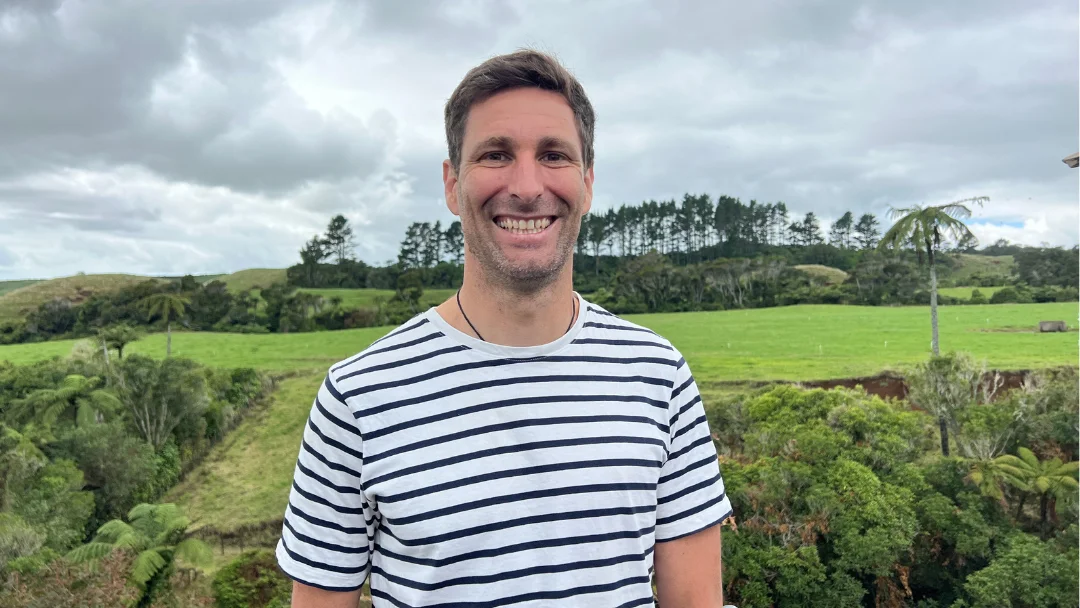
What does it really feel like to leave your homeland, build a life on the other side of the world, and then—years later—make the heart-wrenching decision to return?
This is the story of one French family moving to New Zealand, falling in love with the country, and eventually navigating the difficult path back home.
François arrived in 2008 on a working holiday visa with his girlfriend (now wife), Emily. They never left—until recently, when the pull of ageing parents became too strong to ignore.
Now a French expat in New Zealand with dual citizenship, François has found a unique way to stay connected: he runs a tour company called Kiwis in France, helping New Zealanders discover the very best of his homeland.
This conversation is full of warmth, wisdom, and the kind of perspective that only comes from living between two worlds.
You can listen to the podcast episode with Françoise here, or you can read the full transcript below.
This post may contain affiliate links. They cost you nothing, but we make a small commission. Please see our Disclaimer page for more details.
Do You LOVE New Zealand? Sign up below, and I will send you my FREE Moving to and Living in New Zealand Guide.
A 5 Part Video Series!

The NZ Beginning: A Working Holiday That Never Ended
Liz: Hello, Francois. Welcome to the podcast. I’m so excited to have you here and find out all about your journey—moving to New Zealand from France, moving back, all of it.
Francois: Well, thanks for having me once again. It’s a pleasure to be back. I’m here for a quick holiday to recharge my batteries and come back to my feel-good place.
It’s been a 17-year love story with New Zealand. It pretty much happened by accident, as a lot of things in life do.
Liz: For those who don’t know, Brian and I met Francois when he started the cafe we always talk about. He made this beautiful, French, divine little haven where we’d go to work.
He was always such a friendly, warm, welcoming face. So let’s rewind back to when you first moved to New Zealand from France. Why did you come?
Francois: It happened with my wife, Emily, who wasn’t my wife at that time. I was lucky enough to do a lot of traveling around the world for surfing. She never really got the chance to travel.
When we met and talked about travels right away, there was a real connection point between the two of us. She mentioned she would love to travel but never had the chance.
I said, “Well, we’re young, we can do it. Let’s leave everything behind, sell all our goods, quit our jobs, and go see what’s out there.”
The idea was to start with New Zealand because we could get a one-year working holiday visa. Then if it worked, carry on to Australia, Southeast Asia.
We had a friend trying to set up a surf lodge in Panama. I thought maybe we’d go there. If things didn’t work out, maybe four or five years down the track we’d start again in France from scratch.
That never even occurred. After a few weeks here, we were just like, “Wow, what is this place?” It’s amazing in all regards.
The scenery, the friendliness, the people—so open. They make you feel right at home from the start.
For anyone considering a similar leap, our guide on how to relocate to New Zealand is a great place to start.

The Early Days: Woofing, Fruit Picking, and Holding Ladders
Liz: How old were you when you came? What year was that?
Francois: That was September 2008. Seventeen years ago now.
Liz: So you were just boyfriend and girlfriend in France. What was your job there?
Francois: I used to work in sales and marketing for a French surf company, touring around showing clothes collections and selling surfing products. I’m a surfer.
I’d also worked during summers as a lifeguard on the beach. Can’t complain about that.
Liz: So you’re living in France, you’re young, in your 20s. No children, not married. You think, let’s go on this adventure.
New Zealand was the first place you came, and you never left.
Francois: Yep. Never left. It’s funny because I didn’t really know much about New Zealand. As a kid, I always dreamt about Australia—big spaces, wildlife, animals, ocean all around.
When we were organizing the trip, we thought, “Well, we can start with New Zealand, it’s easy.” We started over there and realized the beauty of the place and how much it was connecting with us right from the start.
We were touring in a campervan and doing some woofing—working on organic farms, helping out in exchange for food and accommodation. We did that all around the North Island.
Then we realized we needed a proper job because we were going through our budget. My wife is a graphic designer, so she could eventually find a job.
But she’s also an equestrian—into horses and coaching. She found a place just down the road from where you live, at a family who had a woofing farm.
Liz: Was that Petra? Rodney?
Francois: Yes, that’s right!
Liz: Oh my gosh. She’s the woman that got me into homeschooling! She was homeschooling her two kids. She’s such a hippie, so open-minded.
Francois: Absolutely. And because they had horses at home, we stayed there for about a month. It was November 2008 when we arrived.
We enjoyed it, but for a whole month we couldn’t see the mountain at the back. It was just raining, gray, windy, terrible weather.
After a month, we thought, “This isn’t the reason we came to New Zealand. We want to see the beauty and some nice weather at the start of summer.”
So Emily found a job as a horse coach in Gisborne on the East Coast. I thought, “Well, I can find some fruit picking over there.”
We moved to the other side of the island and had a wonderful summer there for about four months. Then Emily had the crazy idea to buy a horse.
She came back one evening and said, “I found this horse. I could train it, go to different shows around the country, then sell it for good money and finance the rest of our trip.”
I thought, “Sounds pretty good to me. If you believe in it, let’s do it.”
Liz: That sounds like bliss to me!
Francois: Totally. Just living in the moment, not really thinking about consequences. At some point we realized our time in Gisborne was over.
But living in a campervan with a horse—we couldn’t really travel around with it. We got back in touch with Petra and Rodney, and they said, “Just come back over here and leave the horse while you figure out the next stage.”
So we came back here. It was prime time for surfing—March, April—and I discovered the surfing potential around here. I helped a local guy who was cleaning windows, a good friend of Petra and Rodney. You probably know Jonathan.
Liz: Oh yeah, Jonathan!
Francois: He needed a hand to hold a ladder while cleaning high windows. I said, “Well, I can hold a ladder for a day.” Chatting with him throughout that day, I mentioned that Emily was a graphic designer.
He said, “A friend of mine, Ross Bennett, is randomly looking for graphic designers every now and then when he’s under pressure.” I introduced Emily, and a few days later she managed to get a job with him and get a sponsor for a work visa.
That extended into sponsorship for residency a few years later. Everything kind of happened by accident, by opportunities coming our way.
We thought, “As long as we don’t have to push things to make it happen, let’s embrace it.” That’s pretty much the whole story about New Zealand—things coming our way naturally.
We decided to stay. This is a perfect example of why we always say it’s about connections. Our guide to life in New Zealand is full of stories just like this.
Do You LOVE New Zealand? Sign up below, and I will send you my FREE Moving to and Living in New Zealand Guide.
A 5 Part Video Series!
Learning English One Coffee at a Time
Liz: There’s loads I want to unpick. First of all, was your English as good as it is now?
Francois: I still don’t consider it to be that good.
Liz: Your English is excellent, by the way. I know you don’t like compliments, but it is. Was it always that good?
Francois: No, no. It was very, very basic. I thought I could probably find a job in marketing, but I wasn’t confident enough to justify my skills and be able to work here with such poor English.
I thought, “That’s all right. I’ll use this time to learn something different.” Working in cafes, I had a lot of people coming in, being curious about my story, asking me questions.
I found out I was pretty much always telling the same story. I was feeling more confident telling it, more confident in my English. I would pick up slang, vocabulary, everything that would try to enrich that conversation every time.
Because I love interaction with people, I never got bored doing this—telling the same story over and over.
Liz: You’ve always loved talking to people. I can see that. So you come over to New Zealand, and this is what I love about you—you’re willing to turn your hand to anything.
You didn’t come over and think, “I’m not fruit picking, I’m not going to hold a ladder for someone, that’s far beneath me.” No. You turned your hand to barista, to pastry chef.
And then it led to this opportunity of buying a cafe with your friend Pascal.
The Birth of a Cafe and a Friendship
Liz: How did you and Pascal meet? Because that’s when Brian and I discovered you—two French guys running this cafe in rural New Zealand.
It was honestly bliss. You did these delicious pastries, fantastic coffee. It had a real French-Kiwi feel to it, your accent. It felt like a little bit of Europe but Kiwi as well.
Francois: It’s a big story, full of things that happen by chance. It was in the first or second year we were in New Zealand, living in New Plymouth.
Pascal was traveling with his wife through Australia and had a big issue with their van that just died. They were stuck over there, not knowing what to do.
Through professional contact on LinkedIn, he was in touch with Emily. He knew she was around in New Zealand. He said, “We just crossed the ditch and don’t know what to do.”
Emily said, “Just come over, put your bags down, and discover New Zealand.” They came and stayed with us for a couple of weeks. Right away, we bonded.
We had a good time together. They stayed for a few more months traveling around New Zealand, then had to go back to France.
Pascal had worked at Petit Paris for a while and was really interested in turning into a pastry chef. He fully retrained for about five years in France, learned with the best, worked in a lot of different high-ranked restaurants and caterers.
He came back here with a lot of knowledge and experience, always had that attention to detail. He came back to work in a shop in New Plymouth called Emileu because Matt, the owner, was French as well. He worked there for a year.
At that time, I had started High Tide with a cabin at the beach, and two years later managed to move into where it is today on the main road. I told him, “Well, he managed to get New Zealand residency and wasn’t really linked to his job anymore.”
He thought, “I want to do something different.” I said, “Come and work with me. We can do something really nice and think about what the future can bring.”
When two creative minds come together, there’s a lot of ideas—even outside the food industry. Then the Oakura School contacted us for their 100-year school gathering. They needed catering.
Of course, I’m the same in everything I do—I never say no. It was Tash who approached me: “We’re looking at having a big fancy dinner for 200 people at the hall. Do you think you could do that?”
We had that tiny little kitchen at High Tide—just a work space. I said, “Yep, we’ll do it. We’ll work out the details after.” I came back to Pascal and said, “I think I found our next project.”
He said, “Okay, what did you find?” I said, “Well, we’re going to have a big three-course dinner for 200 people at the hall, and it’s really fancy, so we have to put the bar really high.”
He was like, “Are you crazy? We only have that bench space to work out of.” I said, “We’ll work something out.”
After hours, we were studying, preparing things, looking for recipes. At the same time, we were thinking about a name for the business. There weren’t many catering companies around here, so maybe we’ve got something there.
That dinner went very, very well. Local people really enjoyed it.
Liz: Was it stressful?
Francois: Extremely stressful. We had so many things happening in the night. Things were baking in the oven, and at some point, we realised the fuse had gone off.
For two hours, we thought the oven was on, and it wasn’t. We found that 20 minutes before serving.
Liz: Oh no, a chef’s worst nightmare.
Francois: Pretty much. Especially for your first experience. But because we’re skilled at working things out, we managed. We talked with the organizer and tried to save time and change the schedule.
They had an auction night as well, so we said, “Instead of having the auction at the end, fit it in now.” We changed a few things around. I don’t think anyone in the room really noticed what happened.
They were really happy with the dinner. On our part, it was the most stressful you can get. At the end of the night, we just thought, “Wow, we managed. We worked it out.”
That was the start. We started advertising and getting jobs coming. For a year, we did the two businesses side by side, to the point where Pascal went a little bit more in the kitchen while I was still at the cafe.
I realized it was time to try and focus on this because it can provide us a really good lifestyle doing something we like. On demand, we know numbers beforehand. If the surf is good, we can just say no to a function or work our production around that.
We decided to put the cafe for sale. Ming was happy enough to buy it, and I could focus on the catering.
Liz: So now I know a lot more about the story. I didn’t know it was so stressful at the start! And in case you don’t know, your catering business was famous throughout New Plymouth.
You guys were known for top-notch catering. You made it really high class and special.
Do You LOVE New Zealand? Sign up below, and I will send you my FREE Moving to and Living in New Zealand Guide.
A 5 Part Video Series!
The Pull of Family: Why They Returned to France
Liz: So here you are, living the dream in New Plymouth, Taranaki. You’re surfing, you’ve got your catering business, you’ve created this fantastic cafe, working with your best mate. Had you had children yet?
Francois: Anaia was born when I first started High Tide, at the very start of that business, which added another workload. But yeah, it made us feel even more at home.
Liz: Was your wife happy? Is she your wife now?
Francois: We got married a couple of years after we landed in New Zealand. We went back to France for the wedding.
Liz: So now you’re married. How many children have you got? A little girl?
Francois: Yeah, yeah, yeah. And she’s a Kiwi—a New Zealand citizen.
Liz: Have you got your New Zealand citizenship?
Francois: Yeah, I got it a few years ago. The New Zealand citizenship ceremony experience was really special.
Liz: It feels good, doesn’t it? Feels like you’ve won the lottery.
Francois: Well, yes, but that wasn’t the first feeling I had. The first feeling was just, “Thank you, New Zealand, for accepting me on board and giving me that little piece of paper of a place where I belong.”
Not that I felt like I deserved it, but it was kind of closing the circle. I feel like I’m at home here. This is my right place. The only thing missing to recognize that was that passport and citizenship, but I already felt like a citizen for a few years before.
Why Leave France and live in New Zealand?
Liz: Before we talk about you leaving New Zealand, I have a few things I’ve always wanted to ask a French person. I absolutely adore France. To me, France has got it all—weather, diversity, scenery, beautiful food, wine, Europe on the doorstep.
I always wonder why a French person would leave France. How does a French person feel when they come to New Zealand? You seem to have really embraced New Zealand.
You said to me before, “New Zealand is my happy place, New Zealand is my home.” Was there anything about France that you just thought, “God, I missed that so much?”
Francois: First, I would say everything you mentioned, you can find it here. You’ve got great people, great food. Even if traditional food isn’t the highest standard, you’ve got amazing products, so you can recreate everything that’s in France food-wise.
The weather is exactly the same—just six months apart. Same seasons, same average temperature. You’ve got great spaces around. You’ve got good wine in New Zealand. I would say not quite as good as some French wines can be, but you’ve got those.
I would say you pretty much have everything, plus a great lifestyle. Plus, at that time, we were kind of sick of people—all those cliches of French people being grumpy and arrogant and rude.
Liz: Are they?
Francois: No, but that’s why we were feeling that way at that time. Coming here, people are just so happy in general. So friendly and outgoing, and they welcome you.
The main thing was that Emily wanted to discover the world, and I was just keen. I’m not attached to New Zealand. I’m not a really strong family person—but we’ll come back to this later in the reasons for coming back to France.
I always had that feeling that I wasn’t fitting in in France.
Liz: Really?
Francois: Yeah, especially in the work industry. There’s a lot of pressure put into you in Europe in general. You have to do your studies, you have to know what you want to do when you grow up.
I had big arguments with my dad when I was at high school, not being able to answer what I’d like to do when I grow up. Then you get into your studies, and always in the back of your mind, “I need to get the right studies, studies to get the right job.”
As you progress, you have the pressure of finding a job after that, competing with 500 other people for one job you probably don’t necessarily want to do in the first place.
I’ve always been doing a lot of bits and pieces. Even though I specialized in an industry, I always found it hard to find my place there.
Liz: Find your place, yeah.
Francois: Absolutely. A lot of pressure, a lot of competition. I’m highly competitive with myself, but I don’t embrace it on a big level, especially when you’re competing with other people who are in the same situation, fighting for a job they don’t necessarily want but need for a living.
I was just like, “No, no, let’s go and get out.”
This resonates with many people who end up moving to New Zealand from Europe—the search for a different pace of life.
The Glasses Analogy: Seeing the World Differently
Liz: I’m trying to find a little crack because you are so pro-New Zealand. Did you feel like you had to become more Kiwi, or did you feel like Kiwis accepted you for being French?
Francois: Even though I love New Zealand so much and feel right at home—this is my happy place—I’m French at heart. I was born in France. I’ve got my own character, brought up that way. I always thought I could bring something else.
New Zealand is a big melting pot of a lot of different cultures. I think it’s really important when everyone from those different cultures can make it a big thing, a big picture, and bring their own part to it.
That’s why I could feel right from the start, people being interested in who I was, what was my story, and what could I bring to New Zealand. That’s where I found my place.
A Kiwi told me right when we arrived: “Let’s imagine everyone on this planet sees the world through glasses. In New Zealand, through education, through the way of living, everyone sees the world through blue glasses.
You can see everything that’s happening with a blue hue to it. You come from France, and in France, everything’s seen through red glasses because of education, the way of living, through media, everything. You tend to see red.
When you come from France to New Zealand, you will never in your life be able to see through blue glasses because you’ve got that red hue to it. And on the other hand, you never see red again. You see a mix of both.”
Liz: I love that.
Francois: So I feel like in my right place here, but I will never be a Kiwi born and bred. Moving back to France now, I’m still French, but I also bring my Kiwi culture back. I’ll be different as well.
I want to bring that into the French culture and bring my knowledge and my experience to that.
Liz: We’re all citizens of the world pretty much. I like that about the blue glasses and the red glasses. I love it when people give you visualisations to think about.
The Difficult Decision: Why Leave New Zealand?
Liz: So here you are, living the dream. You’ve got your daughter, your wife, your best friend working with you, building a house on a piece of land. So why did you go back to France? Why did you leave?
Francois: Well, we had our parents calling us within a week apart, pretty much, telling us, “Now we’re getting a bit too old. We’re not going to come and see you in New Zealand anymore.” They’re in their early 70s.
Even though they could still do it, they were saying it was going to be a struggle for them to come and visit. We went to my sister’s wedding a few months later, and that’s when we realized—wow, in the 15 years we’ve been in New Zealand, we only went back to France twice, relying on our parents to come every three to four years.
We thought, “If we go back to the wedding, and we go back on average every seven or eight years, could be the last time we see our parents.” That was a big shock.
Realizing, “Wow, is that fair? What do we say if it’s the last time we see them?” And for our daughter as well, not being able to see her grandparents, her cousins she had never met in France.
We thought at first, “Let’s go to the wedding and feel the temperature, then come back to New Zealand and decide if we pack our bags.” But we thought we might as well use that opportunity to go.
I think we’re a bit the same with Emily. When we have something in mind and take a decision, we just give it all. It would be very hard to go halfway and go to France not knowing. We always have something putting us back eventually.
So we thought, “Let’s do what we did 15 years ago. Sell everything we have here and move back to get closer to our parents.” That felt like the right thing to do at the time.
It’s great that we were living our dreams here, and I think it’s really important to do it. But family and parents are a big part of who you are. Even if you don’t live for them, we thought that was the right thing to do.
So we thought, “Let’s sell the house, even though we were just in the building stages, and go back to them and embrace that for the time being.”
This resonates deeply with our post on why people leave New Zealand—sometimes the pull of family is the strongest force of all.
The Little Things That Nudge You
Francois: It’s funny how things and your mind start going that way as well. Emily came back one night from work and said, “You know, everything’s great here, but you go from Bluff to Kaitaia, and you always have the same food. It’ll be pies, fish and chips, and random things.”
“Even though the accent and people are a bit different, it would still be the same way of thinking.” In France, you’re in Europe in general. You drive a couple of hours away, and it feels like you’re in a different country.
Different scenery, different culture, different dialects, different languages, different food specialties. There’s so much in that regard, and culture and history as well. We kind of missed that.
I remember I was helping at High Tide at that time. There was this local dad who came in with his daughter. They had a coffee. It was a quiet time in the morning. While he was having his coffee, the screen with all those different pictures was rotating.
The little girl was looking at it. She said, “Oh, Dad, Dad, is that real?” She was showing a photo of the Vatican. He said, “Oh, yeah, yeah, it’s a place in Europe. They’ve got a lot of old buildings.”
I was just thinking, “Wow, Kiwis growing up in New Zealand don’t get to see all this culture and history.” It’s pretty important, especially for our daughter. She’s Kiwi, but she’s got French influence as well.
I’d be grateful for her to discover all this. Probably a good time to do it. If she grows older and we decide to go back when she’s a teenager, it will be so hard for her to readjust.
New Zealand’s not going anywhere. We all have citizenship, and this is our place at heart. So let’s go to France for the time being, enjoy that time with our parents, and see what tomorrow will bring.
Liz: I remember you telling us. I’m not going to lie, we were like, “Oh no, please don’t go back to France. Don’t take this cafe away from me.”
Francois: I had so many people mentioning that.
Liz: It was a big loss to the community. But I remember chatting to you about it, and I got the feeling that you were torn. I could see that you were torn.
As a mother, I understand that once you have a child, it’s not only about you anymore. It’s about them reconnecting with their grandparents. That’s huge. So I can understand why you went back.
The Return to France: Grief, Adjustment, and Starting Over
Liz: So you go back to France. How was that? After all that time in New Zealand, how was it?
Francois: Hard to describe. The excitement of something new and going back, and also the sadness of the loss. We organized a big leaving party, an open invite.
Whoever wanted to come, we talked about it through the community. We were overwhelmed with the amount of people who turned up. We realized we’d touched their lives in some ways.
Liz: You’re well loved.
Francois: That was the feeling I received that night. Emotionally, it was really big. Living with that was a big challenge.
We were going back to France at the right time of the year—start of summer. I had my sister’s wedding right away, so everything was moving. We didn’t really have time to think about what we were doing.
When we make decisions, we’re stubborn about it. We had probably 10 months of living with that idea, so it’s not something that came out of the blue. We knew why we were doing it and the reason. We kind of embraced the fact of going back.
Then, unfortunately, my dad passed away two months after we got back, completely out of the blue. He wasn’t sick or anything. It just happened all of a sudden. He was feeling unwell, and 10 days later, he was gone.
Liz: Oh, I’m so sorry. I didn’t know that.
Francois: Yeah. One more thing that makes you realize everything happens for a reason, maybe. I’m glad I had that time with him. Otherwise, I would have missed out.
And I realized my mom would need me around as well because it’s a big change in her life. Then trying to find our way again, we were just in a new country, really, because we had lived away for so long.
One of the good things that struck us was the way people were—a lot more open-minded, a lot more welcoming, smiling a lot more than when we left 15 years ago.
Everyone’s grumpy, complaining about everything. It didn’t feel the same anymore. I thought, “Oh, yeah, no. You can go and do your groceries, and now you can chat with the cashier, which never used to happen.”
If you had a chat with them, they’d say, “Just leave me doing my job.” That was a big change. “Oh, well, maybe we should give that a good go. There’s a lot of good vibes about it.”
Liz: I always wonder about that. When we go back to the UK now, I also think everyone’s really nice. I remember they used to be right old moaning sods, and now they’re not. They’re really nice.
But I wonder if it’s us that has changed.
Francois: I think so. That’s more what I believe. It shows how much influence you can have as a person and the way you interact with other people.
If you live in an environment where everyone’s grumpy, somehow you show the same on your face. You’re not happy, you’re not welcoming. There’s no reason why people will be smiling back at you if you’re not.
Living here, with the interaction I could have with people and how good I was feeling, I was coming with a big smile on my face. When you do that, people look at you and smile back at you.
If you’re talking to them in a nice way, they can feel that, it resonates, and they’ll be the same in return. This is a classic case of reverse culture shock after living abroad.
The Financial Reality: Selling a New Zealand House to Buy in France
Liz: So you went back to France. No job lined up?
Francois: Nothing lined up.
Liz: Did Emily have a job?
Francois: Nothing lined up either.
Liz: What are you two like? You’re just daredevils, aren’t you?
Francois: That was also part of the process of making that decision. The real estate here in New Zealand had gone crazy—like pretty much everywhere around the world with COVID, but completely out of proportion here.
We realized what we could sell our land and house in New Zealand for and what we could afford in France. Instead of having another 15 to 20-year mortgage here in New Zealand with what we had, we could be mortgage-free in France with something quite similar.
We’re in the southwest of France, which is quite an expensive area as well. That made a big difference. That meant if we could buy something fairly quickly, we had no time frame, but that would take a lot of pressure away from finding a job.
That definitely makes a difference in our everyday life. So let’s do it for that reason. We found a place quite quickly because when we make things happen with Emily, it just snowballs fairly.
Liz: Are you both like that?
Francois: I think both. We are a perfect team. She’s probably faster to go with the decision. I’m more analyzing the situation and trying to measure the pros and cons.
I would be pretty fast at making things happen, but with too much analysis, she would make one. But because with two of us as a team, I would agree on it very quickly. If she says something and I’m like, “No, no, I don’t feel like it’s a good decision. Hold on.”
For the house, for example, we came up with that great offer from someone randomly. She was just, “Oh, no, we should do it.” I said, “Actually, yeah, I think we should.” She makes things happen.
We support each other in any ways, and we work great together. This is a great example of why we recommend reading our moving to New Zealand reminder—going in with both feet, prepared for anything.
Kiwis in France: Giving Back
Liz: Let’s go into the business that you’re now doing that helps Kiwis come to France on holiday. It’s almost like your way of staying connected to New Zealand.
Francois: Absolutely. When we were saying goodbye to everyone here—we took the decision eight or ten months before leaving, so we kind of knew what we were doing—I was telling people we were leaving New Zealand, explaining why.
I’d managed two different jobs, connected with the local community here, met a lot of people in all different horizons. Everyone was saying, “Oh, it would be a big loss.” It would definitely be a big loss for me.
A lot of people were saying, “We’ve never come to Europe, never come to France. We’d love to visit one day.” I said, “Well, now that would be your chance.”
Because a lot of people mentioned that, I remember we talked about it with Pascal quite a bit at work during the last catering season. He’s from Corsica, which is a really beautiful part of the world, and I’m from the Basque country, southwest of France.
I said, “That’s something we could do together or independently—turning into a tour guide, showing people around and keeping that connection with Kiwis.” I thought, “Let’s embrace it and go into that. That’s something I really want to do—kind of return the favor that I got given here.”
Everyone I met in New Zealand made me feel right at home and showed me all the good places. “Oh, you should come around the corner, I’ll show you this nice little village, or there’s a cool little cafe there. Let’s go to that event, that festival.”
People were leading me to the right places. I thought, “I would love to do that, especially because that part of France where I live has so much to offer—gastronomy, culture, traditions, history. And I know it so well because I grew up there. I would love to share that with Kiwis.”
I caught up with a friend of mine, Nicola McLaren, who is a travel agent here in New Plymouth, at World Travellers. I mentioned the idea to her, and she was like, “I think that’s exactly what people are into now, especially with COVID.”
“People not really wanting to travel in big groups, in big buses. If someone gets sick, the whole bus gets sick for the rest of the holiday. Something a bit more personalised, really taking the time to embrace and immerse yourself in the culture.”
I thought, “Great, maybe I’m into something there.” So yeah, that’s how I decided to give it a go. I’ve got nothing to lose. If it doesn’t work, I’ve put my time into it, but it’s not a huge investment financially.
It ticks all the boxes—I can do something that I like, still related to food, connected with Kiwis and sharing, which is what I really like to do. Talking to people and sharing.
Liz: Giving back. I love what you said about giving back what you received when you came to New Zealand. Just paying it back. I think it’s such a fantastic idea.
So many Kiwis say, “If we say we’re going to Europe, where do you stay? How do you know where to go without being with all the mass tourists?” You just don’t want that. It’s expensive, it’s busy, you end up spending your whole holiday thinking, “Just get me out of here so I can have a rest.”
Do You LOVE New Zealand? Sign up below, and I will send you my FREE Moving to and Living in New Zealand Guide.
A 5 Part Video Series!
How Kiwis in France Works
Liz: So what does your tour involve? Are you the tour guide?
Francois: Yeah, yeah. It came from that realization that you just did. When you travel around the world, it’s either you sort everything out yourself, which is amazing experiences—you discover a place, figure out how to do things, navigate into a country you don’t know about with a different language, which is a great way to travel.
Or you hop into a fully made tour where you put your feet up, hop in the bus, they take you from A to B, you take a photo, back in the bus, straight to your hotel. It’s pretty high pace, and you don’t really have much freedom into enjoying things around, immersing yourself.
It’s the kind of tours where you’ll go around the whole of France within a week. It’s just like if you came to New Zealand and said, “I have a whole week, let’s go all around the North Island.” You will see a lot, but you won’t leave much.
I wanted to be something right in the middle. I want people to probably go into one region only and have a good feeling for that. Just really immerse themselves in the local culture and have a good feel for it. Then everything is tailor-made for them.
That’s the feedback I’ve had from a lot of clients who’ve come already, saying they had an amazing time because everything was organized. They didn’t have to think too much, which made it so much easier for them.
I look after everything, take great care of them—from accommodation to transport—organize it, and then I’m the guide on the day. I’m always with them, sharing time, explaining how places came to be, how they are today through history.
We share a lot during the day, and everything is custom-made. I have a tour where we’ll go around the region, but I always ask them in the planning stage, “What are you into?”
For example, if people love golfing, I’ll organize a day golfing. If they’re really into more outdoors things, we can organize some trekking. Where I live is part of the Camino track that goes to Santiago de Compostela, so we can have a couple of days walking on that Camino.
Liz: It’s great for your mind, walking for days with your own thoughts. The introspection you can get is really great.
Francois: What I wanted to say is a lot of people have mentioned, “We did in a week what we wouldn’t expect to do in a whole month if we had stayed in that place.” If people had done that travel on their own, they wouldn’t have done half of what they were able to do.
Liz: It takes a local to tell you when to go and what to do.
Francois: Exactly right. On the flight coming here, I was sitting next to a lady who had spent the weekend on Great Barrier Island doing a trekking tour with friends. She was asking what I was doing in New Zealand, talking about life. We had a great conversation.
I mentioned the business, trying to explain it. At some point, I just said, “Instead of going for a tour in a different country, you’re actually going on holiday with a private guide.” That’s the best way to describe it.
I organize everything, but everything is kind of slow pace. We’re not going to rush from one place to the next. It’s really going off the beaten track, going to a village, starting with the market, having a coffee on the town square, seeing life around, trying to breathe in the local lifestyle. The pace of life.
Seeing people, what they do. Going to the market, walking around the village. The ones I choose have something specific about them—a medieval castle or medieval enclosure, so you can walk around those cobblestone streets.
Even for me doing it, I love it. Going to those awesome restaurants off the beaten track that no one talks about, no one knows about, that you just have to stumble across. But because I’ve done that work already, it saves a lot of time.
Meet a lot of local people—local vineyards, local cheese-making places. Not a big factory, maybe just a couple doing their own goat cheese in their farm, in their garage, and explaining the whole life story around it.
Everything is really slow pace. If I see people want to see more in a day, I can move on to something else. If the pace is a bit too fast, which has never happened, we can slow down even more. It’s really about taking the time.
Liz: Sounds divine. And stepping back, slowing down is really important nowadays.
Francois: Everything is fast-paced. That’s the thing about those organized tours most of the time. It’s a great way to do it, and I understand that. They go with big numbers, it’s within a good budget, and that’s what people can afford. There’s nothing wrong with that. I’m not judging anything.
But really, what I wanted to offer was something different. Take the time to breathe. You’re on holiday more than anything. It’s not because you’re going on the other side of the world to visit a place that you have to rush to try and see a lot.
You don’t really bring back a lot of memories with you. You’ll bring back a lot of photos for sure. But you won’t say, “Oh, well, I spent that time. I met that person. That afternoon we just stayed there, enjoyed the sunshine, had a glass of bubbles, a glass of wine, and met local people who were very happy to start a conversation.”
That’s what I want to bring, really. For those planning a trip, our guide to the best-time-to-go-in-new-zealand might help—and Francois can do the same for France.
How to Book
Liz: So when can I sign up?
Francois: Just anytime, anytime. There are a lot of good selling points. You realize when you’re on site, sometimes it’s not what you expect. You have an experience, you just think, “Wow, this was it.”
Quite often with me, it would be sitting down for lunch at a nice restaurant that’s really quiet, amazing food, and you can hear the sound of the wind in the leaves. You’re having that great conversation with people about life in general, and the fact of slowing down.
Even myself, I realize, “Wow, we’re sitting down, having a proper lunch. Oh, breathe in, breathe out, and look. We’re having such a great time, such a connection.”
As a person, I’m having a good time, and I can feel people are doing the same as well. That’s really important in life.
Liz: Let’s pretend I’m in New Zealand and I want to visit your part of France. I don’t know where to stay. I’m a writer, so I’m interested in going to places where I’m going to be alone and get some time on my own. Brian’s coming with me too, lucky him. He likes wine and food.
So what do I do? I just contact you, and you book everything for me? Do I book my own flights?
Francois: Yeah, you would have to book your own flight. I look after you from the moment I pick you up from the airport or the train station until the moment I drop you off to continue with your travels.
Liz: Do I book my own accommodation?
Francois: I can sort that out for you. It’s part of the idea, just to make it easier. Depending on where we’re going to go, I’ve got a few different tours. There’s a lot of things as well that I don’t advertise, but I can do because everything is tailor-made.
If you came to me and said, “I’m a writer. I want to go to a special point of interest because maybe I want to write a novel about this special place. I heard a story.”
Someone came last year, actually. She was writing a story about the Second World War, and she was going to Le Quesnoy in France, that village that helped a lot of New Zealand fighters during the war.
That could happen for your book, for example. I can organize something around that. I can find you a great location. There’s a lot of good places of interest around it.
I always try to limit the amount of driving to about an hour each direction. Or we can do an itinerary, but if we do that, it will be at least two to three nights in each place, same to avoid rushing and going from one place to the next.
I look after accommodation that’s very suitable to the place.
Liz: Do we give you a budget, or do you tell us? How does that work?
Francois: It can work either way. I think the best is I can give you a whole tour with accommodation, what we can do, everything that is included, give you a price on that. Then we can just start going around this.
If, for example, you think it’s too much, we can work around it. If you think, “Okay, but I would like to have a higher standard of accommodation,” we can work that way as well. Everything is negotiable.
I don’t use the word negotiable in a way that I’m trying to get the best money I can. It’s really to fit within your budget and the experience that I want to give you and I can provide.
Sometimes, I’m not saying you need to think about a bigger budget, but by trying to cut costs too much, you miss out on a lot. I know my service comes with a cost, but it includes everything you’re going to experience that you probably wouldn’t on your own.
It’s just like everything in life. You can build your own house, but if you get someone to build it, it will probably be of good quality and will probably be done faster. Some things are worth spending for.
Liz: They really are. I was thinking, as you were talking, that I’m a bad example because I’m trying to save money everywhere, sleeping on people’s couches and house-sitting.
Whenever we travel, we don’t pay for accommodation because we use trusted houseitters, but I can totally see how brilliant this would be.
I’ve got a friend, Talitha. She would be perfect for you. She’s always asking me, “Where would I go? Where can I stay?”
To have someone there in the actual country to take you around—it sounds like it takes so much of your time, though. Do you eat dinner with them?
Francois: I spend a lot of time with them throughout the week. It can be anything from five days to two weeks. The tours I advertise, because I have to advertise something to have a starting point, would be a seven-day tour.
That’s a lot of time together. I really want people to also have their own experiences. I try to leave them free time for dinner. We can talk about organizing a day off halfway throughout the tour so they can do their own shopping, souvenirs, wander around town.
If you’re in Biarritz, for example, in the Basque country, it’s a lovely place to stay for a day and just wander around, go to the beach. It actually feels like you’re on holiday.
You’re not rushed into doing the next thing.
The Feedback Loop
Liz: I was talking to Brian this morning, and we were chatting with Danille and Kevin. I know they used your service. They were the first ones actually to come with you.
I was asking her about it, and she said, “It was bliss. It was so wonderful. He picked us up.” She said the best part was driving around and you pointing bits out to them and telling them the history of it.
She said you would never know that stuff. And going to the little restaurants that again, otherwise you just look on TripAdvisor and you go to places where everyone goes. You want to find those little backstreet places.
It’s your dream, isn’t it, when you go away, to be able to find those places?
Francois: One major example would be going to San Sebastian, which is world-famous for its tapas. It’s highly touristic. It’s probably one of the touristic places where I would bring people too, just doing it differently.
Some places are on the touristic tracks for a good reason as well. You can go to San Sebastian and discover the beauty of it. It’s got a lot of great things.
But I know a lot of those tapas restaurants that have their own history—being the first one that was open, who introduced different special tapas that now are really renowned.
All the travelers would go over there, go on TripAdvisor or Google, find the one that’s got the best ratings, and go there. Because that attracts more people with good ratings, more people give good ratings. But they’re not necessarily the best places to go to.
I know those good places. I’ll take you there. If you were looking at the rankings, maybe you’d have five or six reviews because hardly anyone goes there, but they have a place of interest.
Feeding the Fix
Liz: When you get these Kiwis coming over, do you ever feel like, “Oh, I just want to go back to New Zealand with you?” Is it pulling you back?
Francois: No, that actually feeds me with my fix of New Zealand until the next group of clients, until I come back here. It’s that feel-good connection.
I know that New Zealand’s never gonna be too far away. That’s why I wanted to come back every year as well. First, to visit my friends, family, get my fix of surfing, my fix of New Zealand for the rest of the year.
It just makes me realize it’s only a couple of flights away. What my parents weren’t able to do anymore because they were quite old, I can do that. It’s fine.
Liz: You’re back here now for a month, aren’t you?
Francois: That’s right. Getting close to the end of it now. I had such an amazing time. I’m loving everything I do in France. Sometimes there’s challenges, same again.
Realizing that I don’t quite fit in over there. And now I don’t see the world through red glasses either. As we were talking about before, sometimes are a bit hard, especially being self-employed and working from home quite a lot.
Not necessarily getting—because it’s still early stages—too much interaction with other people around. It takes time to create your own network. Some moments are a bit harder.
But I think, “Oh, it’s just right there around the corner.” I come back here, and I’m just like, “Oh, yeah, no, it’s good.” So I’m going back to France with a lot of positivity, a lot of energy.
I use this trip as well for the business to try and grow it.
Grieving Your Old Life
Liz: I feel the need to say this to you. Because we deal with a lot of people who move to New Zealand. They leave their country and move here, and we always say to them, the first two years you’re here, it’s almost like you’re grieving your old life.
You’ve left that life, left your friends, left the way it was. So I can imagine it’s the same for you going back to France. Even though it’s your home country, you’ve been here for 15 years.
You built your community, your network, your life as a couple and a small family. To leave that and go back home—people just think, “Oh, it was easy. You were just going back to where you’re from. No problem.”
But you don’t slot back in.
Francois: No, life’s change over there, and we’ve changed as people as well. Even though we came back to a region where I was from, so I know people around—I’m only 20 minutes drive away from where my mom lives—and it’s a really, really beautiful corner of France.
Probably if it was to go anywhere in France, wouldn’t have gone back. We knew where we were going to, so that made things a lot easier. But yeah, you’re starting your life from scratch again.
We’re very privileged, as I said. We’re starting our life from scratch again, but we were able to buy our house and be mortgage-free. That’s a massive step. I know a lot of people from my age are not in that situation. So I definitely understand that.
I can’t complain about anything, and having difficult times sometimes, I realize that we’re very privileged, and we’re making things happen, but definitely takes a while.
Probably as you say, two to five years here to really start getting where we wanted to be and get the ball rolling. I don’t think it’s going to take the same, and there’s nothing wrong with that.
You just got to be patient with yourself and see the good reason of the place you’ve got to. If you grieve too much and always keep looking back, you never move forward.
That’s also why we wanted to, when we took the decision of leaving, say, “Well, let’s not hold onto our house here, because then we always have something putting us back behind.” Just cut everything, go this way fully.
If it doesn’t work out, you can just come back again or even go somewhere else. If someone had told me 15 years ago, “Oh, are you going to live in New Zealand?” Who knows? I would have laughed.
And then if three, four years ago, someone told me, “Oh, are you ever gonna go back to France?” “No, I don’t think so.” Things happen. You have to go with your thoughts and what you feel like. You can’t really go and stay halfway. Otherwise, you never progress.
Liz: I love that. That’s so true. I love your spirit—the way you say, “We’ll just go there, and we’ll make it work. If it doesn’t, as long as you’re healthy, it’s the most important.”
Even if we lost our house for some reason, financially everything is dramatic, we have to start from scratch again. I mean, we’re still young. And even if we’re not, as long as we’re healthy and we’re in a happy place, it’s the most important.
You create a good network of people around you, and that’s what really matters. That’s our way of living anyway.
Liz: And it’s obviously working. This is a powerful moving-to-new-zealand-reminder—that life is about the journey, not the destination.
Advice for French People Wanting to Move
Liz: Before we sign off, if we’ve got French people watching this—we do get a lot of people from Europe—and they’re thinking, “I’d love to move to New Zealand, but I don’t know. Will they accept me? My language.”
What advice would you give to French people wanting to move to New Zealand?
Francois: Just thinking about it, just make it happen. You will never, ever regret it. It’s only good things that’s gonna happen to you. Even if for some reason you couldn’t stay here—especially younger people, you can have a working holiday visa and come here for a year and kind of try that, travel around.
If they can’t get a work visa behind that, well, at least you had one year to experience it, and maybe some opportunities will come, and you’ll be able to stay.
If it’s people who decided to move over here because they can get a job and get a work visa that way, it’s worth taking the risk. If it didn’t work, you’ll come back as a greater person and improved, with an amazing experience.
To be honest, I don’t really see things not going your way when you come here. It’s only the limits that you can put yourself. There are some places in the world that you can understand—countries being at war, extreme poverty, dictatorships—when they don’t have the choice.
We, especially for people living in France, being able to come here, they’re in the position where they can make a decision, and it can only be for the better, really.
For anyone considering this path, our guide on New Zealand work visas is essential reading.
How to Find Francois
Liz: Thank you for sharing that. Straight out of the horse’s mouth. If you’re French and listening to this, this is it. Francois, thank you so much. I love your story.
I love the whole giving back to New Zealand and that connection you’ve kept. It’s absolutely beautiful. If you’re watching this and you’re wanting to go to France, this is your guy.
You’re offering a fantastic service. And like I say, I love that I keep seeing you back in the village and you’re coming back every year. That’s really important. So good luck with everything.
What’s your business called?
Francois: Very easy. It’s called Kiwis in France.
Liz: Kiwis in France!
Francois: Very easy to find. And you have to start your email with “bonjour” when you inquire about things now. You can email me at bo*****@***********ce.com. So very easy. I try to make it easy for people to get in touch.
Liz: I love that. I’ll put all the links in the description below. You can reach out to Francois, Kiwis in France, book your next trip through him. Thank you so, so much.
Francois: Thank you for giving me some time together. I love having a chat with you. That was one of the reasons for coming back here. Thank you for giving me the opportunity to share my story. Hopefully, that can inspire a lot of people.
I think that’s the meaning behind all this—just to tell people there’s a lot of good things in life. Just slow down, enjoy. There’s a lot of worries, but as long as you’re healthy and you want to do things, just do it, make it happen.
If something you don’t want to do, why should you be doing it?
Liz: Thank you so much.
Francois: Merci beaucoup, Liz.
Ready to Start Your Own New Zealand Story?
Francois’s journey is proof that life is full of unexpected twists and turns. Whether you’re coming to New Zealand for the first time, returning home, or finding a way to bridge two worlds, the key is to embrace the adventure.
Your next steps:
-
Head over to nzahead.com/free for our free 5-day video guide on life in New Zealand.
-
If you’re planning a trip to France, reach out to Francois at Kiwis in France.
-
Join our private NZ Ahead community on Slack for support from people on the same journey.
Wherever your path leads, remember—home is not always a place. Sometimes it’s a feeling.