
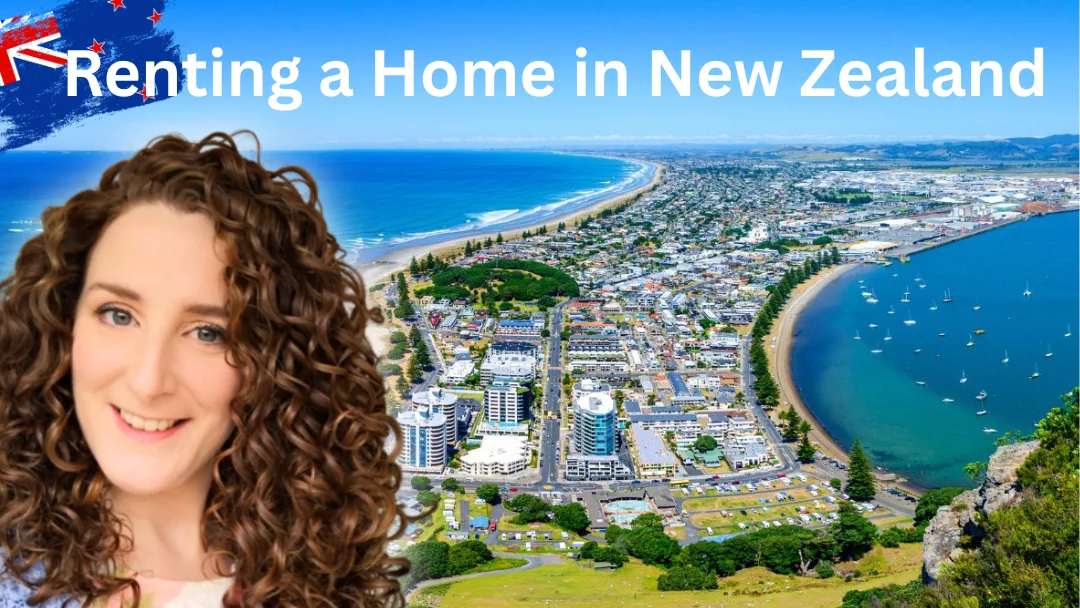
Nikki moved from Manchester, UK, to Auckland in 2022 with her husband and two young daughters.
After navigating the rental market herself, she started As the Kiwi Flies—a service that helps newcomers find rental homes in Auckland.
In this episode, she shares everything you need to know about renting in New Zealand, including costs, processes, and what to expect.
Read the full, raw transcript below to follow their journey! You can also watch the video version of this podcast below or over on our NZ Ahead YouTube Channel.
This post may contain affiliate links. They cost you nothing, but we make a small commission. Please see our Disclaimer page for more details.
Do You LOVE New Zealand? Sign up below, and I will send you my FREE Moving to and Living in New Zealand Guide.
A 5 Part Video Series!

Quick Facts About Renting in New Zealand
| Question | Answer |
|---|---|
| Where is Nikki based? | Auckland, New Zealand |
| How long has she been in NZ? | Nearly 4 years (as of this recording) |
| What does she do? | Founder of As the Kiwi Flies (rental home search service) |
| Average rent for 3-bed in Auckland | $735 per week (as of recording) |
| Bond required | Usually 4 weeks’ rent |
| Rent payment frequency | Weekly (most common) |
Why Renting in New Zealand Can Feel Overwhelming
Finding a place to live in a new country is one of the most stressful parts of moving overseas.
When you’re looking at New Zealand rent houses from the other side of the world, it can feel impossible. You don’t know the suburbs. You don’t know the prices. You don’t know what’s reasonable and what’s a rip-off.
Nikki knows this feeling well. She moved from Manchester to Auckland in 2022 with her husband and two young daughters. She had never visited New Zealand before. Finding a rental from abroad was daunting.
So she did what she does best—she figured it out. And then she started helping others do the same.
Her business, As the Kiwi Flies, helps newcomers find rental homes in Auckland. She does the viewings, checks the suburbs, and takes the stress out of rent in New Zealand Auckland.
In this episode, Nikki shares everything you need to know about renting in New Zealand—from costs and bonds to hidden fees and what to expect.
For those still deciding where to settle, our guide on cities-in-new-zealand can help you choose the right location.
Meet Nikki: From Manchester to Auckland
Liz: Nikki, welcome back to the NZ Ahead podcast. I think this is the third time you’ve been on this podcast now. And so I just feel like, you know, we’re co-hosts by this point.
Nikki: Yeah, I’m pushing Brian out. It’s just me now, me and Liz.
Liz: Tell me a little bit about yourself and how you come to be living in Auckland, New Zealand.
Nikki: Of course. So I’m Nikki and I moved from Manchester in the UK over to Auckland in 2022 with my husband and my two small children at the time who are now growing up in Auckland as little adopted Kiwi kids.
Liz: And for those people who don’t know, Nikki’s business is helping people to find rental homes in and around Auckland. Do you expand further than Auckland or is it just Auckland you concentrate on?
Nikki: Auckland’s the main focus because it’s where I live, it’s where I feel that I add most value but also I do cover the upper North Island really. So down as low as Taupō and then up past Whangārei, Northland. So if it’s within three or four hours of Auckland I’m very happy to go and look at houses for people out there.
For anyone considering moving-from-united-states-to-new-zealand or from elsewhere, Nikki’s experience offers practical insights.
Why Is Nikki’s Service So Valuable?
Liz: I am in awe of your business. This episode is going to be so helpful for those who are moving to New Zealand, particularly in the upper North Island. You’re living in America or South Africa or Canada, UK, whatever, Europe, and you have no idea what you’re coming to. We get here and we stay in Airbnbs or motels or whatever, and we hope for the best.
The fact that you’ve started this business, that you go out and vet these houses and find these houses, and you know all the great locations, and then you work with the people, it’s an absolutely fantastic concept.
Nikki: Yeah, it’s going to be very hard to keep succinct because it’s such a massive topic. I feel like there may be some tangents coming as we go through these five things.
Do You LOVE New Zealand? Sign up below, and I will send you my FREE Moving to and Living in New Zealand Guide.
A 5 Part Video Series!
What Is the Healthy Home Standard?
Liz: Let’s start with number one. We’re going to talk about the Healthy Home Standard, which if you are not from New Zealand, you would not have a clue what this meant. Tell us what this means and what people have to consider.
Nikki: Healthy Homes is the name that people kind of colloquially give to some legislation that came in a few years ago about the standard that a house needs to be to be let out either as a rental home or a holiday home as well.
Its aim is to try and raise the quality of rental homes generally in New Zealand and to ensure that some of the very traditional problems with Kiwi homes that you might hear circulating on the internet are kind of mitigated against.
So really it’s a charter that landlords have to stick to in order to be able to rent out their home. It deals with things like making sure that the living area is heated. It deals with things like drafts, mould, and it sets out how a landlord should be maintaining their property for you as a tenant.
It’s actually really important that people get to know what classes under healthy homes and what landlords are actually obligated to do and what they’re not. Because I always think information is power and you’re coming into this situation probably not knowing a huge amount about Kiwi homes if you’ve not lived in them before.
Liz: So does it just mean like they can’t rent out damp houses or if there’s mould on the ceiling, does it mean that they’re not allowed to do that because they have got to comply to the healthy home standard?
Nikki: So it gets complicated as all legislation does because there’s an element of reasonableness that has to be expected. There are certain things that a landlord wouldn’t be expected to put in because they would be prohibitively expensive for the landlord.
So there is some gray area within there. But for example, one of the most common things that has seen improvements since healthy home standards have come in is that all of the living areas in a rental house now, there must be at least one living area that’s heated.
The most common way that that would be done in New Zealand would be through a heat pump, which is like a big white box on the wall and it does cooling in the summer, it does dehumidifying most of them and it also does heating.
Liz: New Zealand homes don’t often have centralized heating and cooling or central heating like through a radiator system, do they?
Nikki: No, no. And you’ll feel it maybe after you clear off and let Brian co-host again. Because of that, because a lot of the homes don’t have centralized heat, the insulation is extremely variable, including roof insulation. An awful lot of older Kiwi homes that weren’t built recently will only have single glazing, for example.
All of these things are very different than probably the countries that people are moving from. And it is a little bit of a change to get your head around of how things are built in New Zealand. I mean, I don’t know whether you found this, being British, obviously I’m used to houses being built of brick, but in a country that has seismic considerations, brick is not a sensible building material.
Liz: And people are really shocked by that, aren’t they? They’re like, all the houses are just like wooden shacks. And you’re like, no, they’re built to very, very high standards, but they’re built for earthquake proof. So we can’t build them out of stone.
Nikki: And I think all of these things are different than what you’re coming from. So it’s just about understanding what’s reasonable to expect in your rental home because otherwise people can go in and be quite disappointed that there aren’t certain things they’re gonna get like the centralized heat or double glazing. You can absolutely get those things. You just have to pay more money for them. So again, it’s about managing budget expectations as well.
And there are certain things that should be done and maintained by the landlord as part of Healthy Homes. And it’s really important when you’re viewing a house to know what those expectations are so you know what’s reasonable and what’s not.
What Happens If a Landlord Isn’t Meeting Healthy Home Standards?
Liz: Let’s say I’ve got $750 a week to spend in Auckland and I see this house and I absolutely love it. But there is one bedroom that is damp and there’s damp on the walls and it’s cold and it’s a bit mouldy. Would they have to sort it out by law or would they just say, “Well, forget it, I’ll rent it to someone else”?
Nikki: It’s a really annoying answer. There are certain things that landlords are responsible for, but like anywhere, you get landlords that are more amenable and landlords that are less amenable. You get agents that are more amenable and landlords that are less amenable.
And unfortunately, that’s often driven by the market. There are some unscrupulous landlords who will just be like, “Well, you know what, we’ve got three other applicants. So it’s a bit tough if you don’t like it.” Most landlords in New Zealand, they want a good relationship with the tenant. The agent wants a good relationship with the tenant.
Liz: That’s so true. That’s why your service is so valuable. Because who looks after the people renting?
Nikki: Exactly. The agent acts purely in the landlord’s interest here. So there’s not someone looking out for renters. It’s part of the reason why I’m developing this business.
Liz: I love that. You’re sticking up for us renters.
Nikki: The good landlords and the good agents, they will care about the renters. And I think that’s one of the things that it’s really important to get that sense when you’re first dealing with an agent or a landlord—is this someone who’s filling me with confidence that if I come to them and something’s broken, they’re gonna prioritize fixing it?
Just like a job interview, you need to know is this a person I can work with? Because again, a lot of people have been homeowners in their own country. To go back into the tenant rental mindset is quite a big shift when you move into a new country.
Do You LOVE New Zealand? Sign up below, and I will send you my FREE Moving to and Living in New Zealand Guide.
A 5 Part Video Series!
What About Natural Hazard Risk?
Liz: Number two, we talked about the natural hazard risk. What’s the natural hazard risk that people have to be aware of when renting a property in New Zealand?
Nikki: So this varies across New Zealand. As we mentioned before, there is an earthquake seismic consideration. So there are maps that show you where the risk is higher and lower across New Zealand. So that would be something definitely to consider, say around Wellington, for example, and that band of the lower North Island.
For me, where I am in Auckland, just after we arrived, we had a double whammy of the Auckland anniversary floods and a cyclone. So Auckland Council have really moved very specifically on this to try and help people understand flood risk because an awful lot of homes flooded that had never been at risk of flood before. They kind of called it like a one in a hundred years event, but there have been subsequent flooding events in Auckland.
So where you’re moving to will have specific risks and it’s about making sure you check them. For example, when you come to rent a house in Auckland, even on Trade Me now, you can click the flood map, it will show you where the likely floodplains are and whether or not that house is in it.
Liz: Horrible if you were the landlord and your house is sitting right in the middle of the floodplain, wouldn’t it? No chance of renting that then, better lower your rent down.
Nikki: But I mean, people in your community were affected by it, who just moved to Auckland. These houses that were never perceived to be at risk, all of a sudden, it was such an unusual amount of rain. So it’s about understanding what new risks have you got to consider in this new place that you’re moving to that you didn’t have to consider in your home country and making sure that you’ve done the research on them. So I would always say anyone who’s renting in Auckland, check that flood map. Don’t rent a property without checking it.
Liz: Don’t be so scared that you’re like, “No, I can’t live anywhere that’s got the risk of the slightest thing.” I think it’s all about balance, isn’t it?
Nikki: Definitely. It’s really easy to hear these words and especially if they’ve not been part of your life where you’re from, they feel very scary. It’s not just does the risk exist. It’s like, how likely is that risk and how comfortable am I with living with that risk? Different areas of New Zealand have got all of these big scary words—earthquakes, tsunamis, volcanoes—they are scary when you hear them. But keeping the perspective of how likely is this risk and being sensible about it is important.
Next, You Can Watch:
How Do Work and School Affect Where You Rent?
Liz: Number three, work and school. Is this about choosing a house where you work or where the kids go to school? Tell me more.
Nikki: This is often the deciding factor for people. First of all, you’re moving to New Zealand. Okay, you’ve been offered a job in Auckland, so you’re going to be living in Auckland. So that is often the thing that kind of sets your parameters.
School zones have a massive impact on Auckland rent. You can go two streets and move into a new school zone and the rent could jump by $300 a week. Especially some of the areas in the middle of the city, for example, that are in what’s known as the double grammar zone.
Commuting options are also important. Are you definitely going to commute in the car? Are you open to public transport? If you are, how long do you want that to be? The traffic times in Auckland are very different at 7.15am than they would be at 11am. So your start time at work is going to have an influence as well.
I think, start looking at the big picture. Yes, okay, I feel like I want to be in a location, say, that’s got easy access to a beach. What impact is that going to have on my commute? And am I willing to accept that impact? When you rent a house in New Zealand, you’re almost certainly going to have to compromise on some aspects unless you have unlimited budget. So which ones are you more willing to compromise on and which ones are you not? Getting that really clear, I always think people should write a priority list.
Liz: That’s a really good idea.
Nikki: Use it as a way of, okay, this house offers us all of this, but it’s got a compromise that’s in my top two or three that I wasn’t really willing to compromise on. So how do I feel about that? I don’t want people to feel like they have to make a compromise that they’re not willing to, just because they’re so desperate to get a house.
Why Is It So Hard to Get a Response from Agents?
Liz: Why do landlords not get back to people when they’re applying from overseas? Why are they just leaving them with crickets?
Nikki: The agents tend not to reply because it generally works on an open home system here. So you don’t book in a viewing to go and see a house, an agent advertises a viewing time and you get your backside there to go and view the house when the agent says. And so normally, especially in somewhere that’s as busy as Auckland, they’ve got enough applicants who can do that without needing to hold someone’s hand, that they don’t actually need your application at that stage.
Also, one of the things you find with some of the listings, they look live, but they’ve actually effectively been rented. They just haven’t taken the listing down. So you could spend a lot of time chasing a listing that’s not even still accepting applicants.
Do You LOVE New Zealand? Sign up below, and I will send you my FREE Moving to and Living in New Zealand Guide.
A 5 Part Video Series!
What About Amenities and Leisure Time?
Liz: Number four, we’ve got written down amenities and leisure time when renting. Tell me more about that.
Nikki: This kind of ties in with work and school, but obviously people will think more about work because it’s compulsory. We move across the world, uproot our lives, say goodbye to our friends and family, move our kids, because we have this idea in our head about what life is going to be like.
What does “the lifestyle” actually mean? It means something different to every single person. For me, we’ve got kids, they do a lot of extracurricular activities. I don’t want to be the one when they’re 15, 16, who’s having to drive them. I wanted a bus network so that they can hop on the bus and have some level of independence.
How far do you want the beach? Do you want cafes and restaurants walking distance? Or are you happy to hop in the car? What does that lifestyle look like from outside of work? Work’s an easy one to consider because it’s compulsory. But I really would encourage people to think, okay, on my weekends, what do I want outside my house? Where do I want my house to be? What do I want to feel when I walk out of my front door? And do I want to walk? Do I want to drive? Do I want to hop on the bus?
One of the wonderful things about Kiwi life is that it’s not just about work here. In fact, it’s about work as least as we can reasonably make it.
What Activities Do Your Kids Do?
Liz: What activities do your kids do? I’m just dying to know.
Nikki: It would be easier to ask what activities my kids do not do. It’s one of the things we love about being here. My kids are now 12 and eight, just about to be nine. They have been able to launch themselves into sport here. So just so much more access, I would say, at a younger age to that.
So just to give you a bit of an idea, we’ve got netball, hockey, football, touch rugby, athletics, triathlons. We also do a bit of singing, guitar, piano. We’ve got all sorts going on in this house. I’ve forgotten some—cricket and yeah, they are here, there, and everywhere. So basically, if it’s fun with a bat and a ball or with other kids enjoying themselves, they’ll get stuck in.
Liz: Are you living the Kiwi dream there in Auckland?
Nikki: Now, yes, yes, I am. I genuinely feel, in fact, Ollie and I were saying this on the beach yesterday, we’re now both self-employed. And so we have this ability that we never had in the UK to organise our work lives in a way that works for us. My dream my whole life was to live by the ocean and I have that. I watch my kids have this independence, this freedom, this access to all of these things that I don’t feel like I was giving them in the UK. That is why we moved.
How Does Nikki Help People Find Their Kiwi Dream?
Liz: Talk to me about when people come over, they move to New Zealand, they hire you and they say, “Find me a home that I want to feel like you, Nikki. I want to feel like I’m living the dream in New Zealand.”
Nikki: That is fundamentally at the core of why I do this and what I want to do. Yes, okay, I turn up to houses, I view houses, I love viewing houses. I go and sniff in closets and check that they’re not mouldy for people. I’ll go outside and check that the roof isn’t falling off and I’ll highlight any logistical things that might be of consideration about the house. But ultimately, I’m being that person who’s trying to convey to the person who’s working with me, would they get that feeling?
Everyone in house hunting always talks about the feeling, don’t they? And whether I’m with someone viewing it or whether I’m viewing it for them on a video screen, I am obsessive about research. So I will find, I can’t tell you the number of YouTube videos I watched of people just driving around the areas we were considering. And so this is what I want to help people with.
Yes, I can show them a house. Yes, I can smell the closets. But I also will get in the car and drive the commute to school or I’ll show you where your nearest gym is or I’ll drive and show you what the cafes are like or I’ll walk you to the nearest park or to the beach and film all of that because I want people to have a real sense of what not just this house is but what this life is. And is it giving them when they sit in their living room back at home and they close their eyes and they think, this is what it’s going to be like when I live in New Zealand?
I want the whole picture to resemble that as close as possible. And yes, I’m going to give them a dose of realism, maybe on budget or modern versus older. But does it look like it looks when you close your eyes? How can we get you as close to that within your realistic budget constraints as possible? And that’s my favourite bit.
What If You’re Bringing Pets to New Zealand?
Liz: What about if you’re bringing pets to New Zealand? Am I going to have a chance of finding a rental if I’ve got pets?
Nikki: Absolutely you are. It adds another layer of complexity. It means that you need to be even more patient and persistent. You might not get the first house you apply for. You might not get the second or the third. So you’ve got to be in for the long haul.
But ultimately the pets also come with the same considerations as the tenants. You’re showing that you’re a person who’s going to pay on time, that you’re a person who’s going to look after the property and that you’re a person who’s easy to work with. And you actually just need to do the same for the pets.
The legislation changed in New Zealand in December 25. So it’s still relatively new where the onus is now much more on landlords saying yes to pets than no. With it has brought a whole load of other protections for landlords to try and reassure people that if a tenant does damage your property, you can charge an additional pet bond or deposit of two weeks rent. And that means that there’s a whole range of landlords opening up rentals to people with pets who six months ago would have just said blanket no pets.
Liz: I’m so happy about that because we have so many people in the Slack community that are bringing their pets over. It’s just about communicating. Someone in the community made a little video of their dog, like doing all these different activities, and they sent it as part of their application, which is such a good idea.
Nikki: Exactly, and that’s what the landlords want. They want that reassurance that having the pet in isn’t going to increase the risk. And this is actually where if you are a homeowner in your own country, that can be a real advantage. The fact that you can say, “I’m going to be a landlord or I’ve owned my own home, I understand your perspective,” is a real advantage for people, especially with pets.
Next, You Could Watch:
What Are Nikki’s Favourite Moments of Helping People?
Liz: What’s been your favorite moment since you’ve been doing all this?
Nikki: I could give you 10 answers to that question. But the one that stands out was one of our very, very early clients. They were lovely. Moving over from just outside Chicago in Illinois and moving with two big dogs, Husky Cross. So pets adds a whole layer of complexity.
They were getting nowhere. They couldn’t book their pet relocation until they had a permanent address. They kept needing a Kiwi phone number to be able to book certain things and they were just going round and round in circles. I just said to them, “Put my address and then you can swap it when you’ve got your own.” Through the screen, the relief that I could feel with them that it was that simple. They said, “We’ve been struggling with this problem for four weeks and you literally just solved it for us.”
All of the things I would have answered to that question are those moments where people are struggling and it seems so hard and there’s something tiny I can do and it makes it easier for them. That is all I really want to do in this business.
How Can People Contact Nikki?
Liz: If people want to reach out to you, what’s the best way they can find you?
Nikki: The easiest way is to go onto my website, which is www.asthekiwiflies.com. There’s multiple ways to contact me on there. I’m a WhatsApp girl, so there’s a direct message to WhatsApp. If you just want to send me a message, email, you can check out all of my services there.
One of the things that I’m really keen to do with this business is to not keep it all behind a paywall. So if you have messages that you want to send and just a quick question, please reach out to me. Don’t feel that if we’re not working together that I’m unavailable to help you.
If you’re looking for someone who is gonna be obsessive about finding you the right house in Auckland, then do get in touch because I love talking Auckland houses. I love talking New Zealand. Just get in touch if you’ve got questions and I will help.
Liz: Thank you for being part of the community and just being there helping people. I always see you on the housing channel and you’re always on there chatting and helping people. We value you being part of our community.
Key Takeaways for Renting in New Zealand
| Tip | Why It Matters |
|---|---|
| Understand Healthy Homes | Know what landlords are legally required to provide |
| Check flood maps | Avoid properties in high-risk areas |
| Research school zones | School zones can add $300+ to weekly rent |
| Consider your commute | Traffic times in Auckland vary significantly |
| Make a priority list | Know what you’re willing to compromise on |
| Be patient and persistent | The rental market moves fast but don’t settle |
| Get help if needed | Services like As the Kiwi Flies can remove the stress |
Frequently Asked Questions About Renting in New Zealand
Q: How much is rent in New Zealand? A: The average rent for a three-bedroom house in Auckland is about $735 per week. Prices vary by location and property size.
Q: Do I need to pay a bond when renting in New Zealand? A: Yes, usually four weeks’ rent as a bond. You may also need to pay one to two weeks’ rent in advance.
Q: Is it easy to find a rental in New Zealand? A: The market moves quickly. It’s important to act fast and have your documents ready. Using a service like As the Kiwi Flies can help.
Q: What documents do I need to rent in New Zealand? A: You’ll typically need references, proof of income, and identification. Sometimes you’ll need a cover letter explaining why you’d be a good tenant.
Q: Are utilities included in rent? A: Usually not. You’ll need to budget for power, internet, water, and sometimes gas on top of your rent.
Q: Can I rent a house in New Zealand before I arrive? A: Yes, but it’s challenging. Services like As the Kiwi Flies can help by doing viewings on your behalf.
Q: Can I bring pets to a rental in New Zealand? A: Yes, but it adds complexity. Pet bonds are now allowed and more landlords are open to pets.
Nikki’s Advice for Renting in New Zealand
| Advice | Why It Matters |
|---|---|
| Do your research | Know the suburbs and prices before you arrive |
| Budget for extras | Utilities, school costs, and bond add up |
| Check flood maps | Avoid properties in high-risk areas |
| Look for a good landlord | Communication and trust matter |
| Know Healthy Homes standards | Know what landlords are legally required to provide |
| Don’t rush | Take your time to find the right place |
| Get help if you need it | Services like As the Kiwi Flies can remove the stress |
Ready to Find Your Rental Home in New Zealand?
Nikki’s story proves that renting in New Zealand doesn’t have to be overwhelming. With the right research, the right support, and the right mindset, you can find a home that feels like your Kiwi dream.
If you’re ready to start your search, here are your next steps:
-
Head over to nzahead.com/free for our free 5-day video guide on life in New Zealand.
-
Join our private NZ Ahead community on Slack for support from people on the same journey.
-
Find Nikki in the Slack community or contact Nikki at As the Kiwi Flies for help finding your Auckland home.